Toast to the Queen - Burns Supper Jan. 22, 2000
By Doug Macdonald
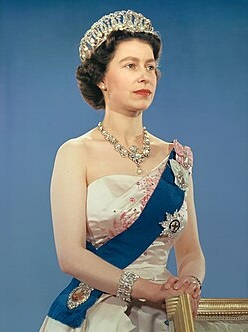
It is traditional on these occasions to present a toast to the Queen. We in the RSCDS toast her particularly as the Patron of our Society. It is by virtue of the Queen's patronage that the Society can call itself Royal. But, to be truthful, the Queen's role as Patron does not have a lot of day-to day impact on the Society. In actuality, the Queen's duties as Patron don't occupy a large portion of her time. She doesn’t go to class regularly, and, although she has visited Headquarters in Edinburgh, she doesn't come in to work every day.
But it is appropriate, particularly this year, to remember the one occasion on which the royal connection made a fundamental difference to the direction of the Society.
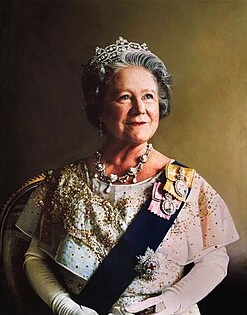
It was before the Society was Royal; it was just the Scottish Country Dance Society back then. And it was before the present queen was on the throne. The king was George VI, and his wife was another Queen Elizabeth, who had been born into the minor nobility as Lady Elizabeth Bowes-Lyon.
Neither George nor Elizabeth had been raised to be King and Queen. George was the younger brother of the heir to the throne, and was expecting to live out his life as the Duke of York. It was only when his older brother, Edward VIII, abdicated the throne to marry the woman he loved, that George and Elizabeth were forced, somewhat unwillingly, into the role of monarchs.
Neither was particularly fitted for, or comfortable with, the role. George had a bad stutter, and both of them were painfully shy in public situations. Their subjects, too, did not know quite what to make of their somewhat awkward new sovereigns, It wasn't until their decision to remain in London during the worst of the German blitz that they won the virtually universal respect of their subjects.
As most dancers know, another story of heroism which came out of that war was the story of the British soldiers who, during their time in a German prisoner of war camp, devised a dance in order to maintain a part of their heritage under very difficult conditions. That dance was “The Reel of the 51st Division”. After the war, this episode came to public attention. Dancers worldwide expressed the opinion that this new dance should be published as part of the Society canon.
Who could resist the appeal of a story like that?
Well, what the histories of the Society will not generally emphasize is: The Society could resist it. Notwithstanding public opinion, they weren’t inclined to make an exception to their longstanding tradition of publishing only dances from old manuscripts of the 18th and early 19th centuries.
But then the Queen spoke up ...
"Well, I don't see why you can't make an exception.", she said. I'm paraphrasing here, since I wasn't there. We'll probably never know if this was just an offhand whim or a deeply held conviction, but one of the benefits of royalty is that even those offhand whims have the force of majesty behind them. Scottish though they were, the ladies of the society were still loyal subjects of the crown, and thus, "The Reel of the 51st Division" appeared as dance #10 in Book 13, called the Victory Book, published in 1945.
Contrary to the fears of the Society, this action did not open the floodgates to the introduction of modern dances. Eighteen more years went by and eight more books came out before another contemporary dance appeared in a Society book. In the meantime, the devising of new dances, which had always been going on to some degree, gradually gained acceptance. More and more devisers took to publishing their own dances: James Cosh, for instance, published "Mairi's Wedding" in 1954. Finally, in 1963, the Society published Book 22, which was made up entirely of dances of modern devising. Dance #1 in that book was "The Reel of Mey", which is on our program tonight, and could legitimately be said to be the second modern dance published by the Society.
It is interesting to speculate on the current state of dancing if the queen's opinion had not carried the day. John Drewry would be a pensioner dancing in his local class in Aberdeen. The Society, after publishing 40 books of dances from old manuscripts, would probably be starting to seriously worry about how many old manuscripts were still around. We wouldn't have the Rondel or the Knot; we wouldn't have the Tournée.
It's not an unmixed blessing as you can see, but I think that no one today would argue that the dancing is not a richer art form by virtue of being a mixture of the old and the new, of the traditional and the modern.
We would also have missed out on a peculiar form of genius. People like James Cosh, Roy Goldring, Derek Haynes, Hugh Foss, and Bob Campbell, although they might be well remembered by their local branches, would not have made a contribution which will literally live as long as the dancing does. It is satisfying to know that when the next century rolls around, dancers, maybe right here in Dabney Hall, will welcome it with "Mairi's Wedding" and "Let's Have a Ceilidh” and maybe even “The St. Nicholas Boat”, as well as "Corn Rigs" and "The Lea Rig".
And talk of centuries is appropriate here: Queen Elizabeth, that former Elizabeth Bowes-Lyon, who played such a fundamental part in starting it all, will celebrate her 100th birthday on August 4 of this coming year. So, I would invite you all to be upstanding and join me in a toast to Queen Elizabeth, the patron of the Society … and to Queen Elizabeth, the Queen Mother.